
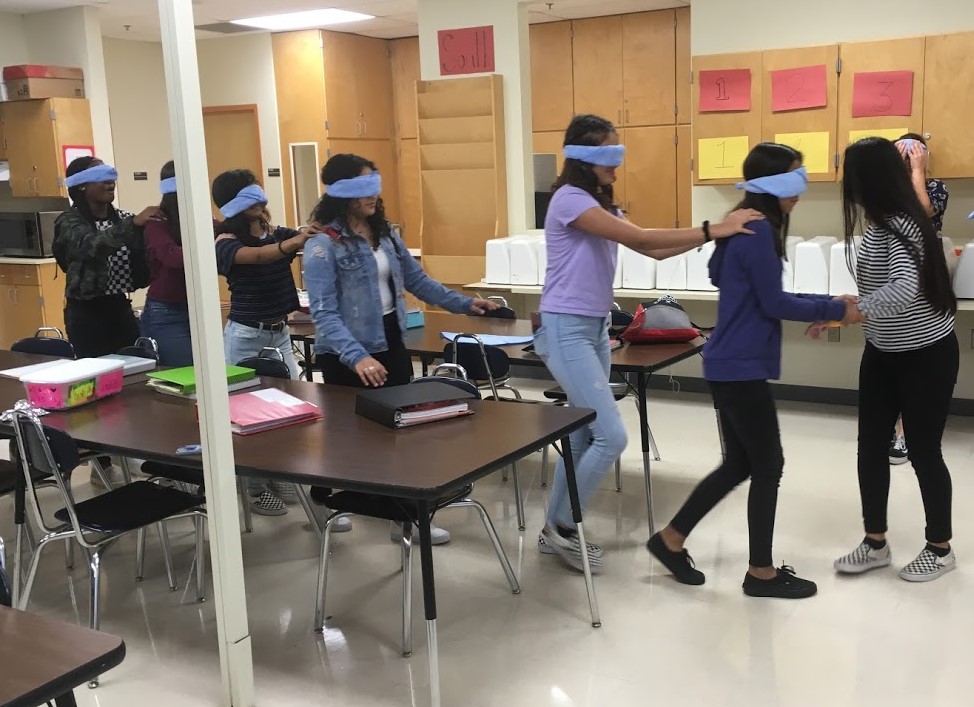
Middle school students, at least in the United States these days, have a unique challenge facing them. There are different types of Middle school students. You have the “new to this middle school thing” as transitioning low-level 5th or 6th-grade middle school students. Then you have the right-in-the-center middle school student. These 7th graders probably do the most growing in one year. Finally, there are the 8th graders. This is the group that is often playing the role of “big fish,” forgetting how small the pond is and that they are about to be dumped in the ocean of high school. There are varying concerns and learning diversity that goes on in middle school.
And yet all of these 55.1 million students, middle schoolers included, suddenly found themselves in the same situation where they had to learn how to shelter in place and live in confinement, and many had to learn to swim in the sea of distance learning or sink to their academic demise. I am both a distance learning teacher and a distance learning college student. I feel like a pro at this distance learning thing. However, there is a challenge in that it is not equitable and yet the U.S. Department of Education stated in recent guidance that it “does not want to stand in the way of good faith efforts to educate students online.”
Social media has been flooded with heroic stories (and certainly some complaints, but mostly praise) of elementary school teachers providing adapted lessons and doing things like sending “Flat Teachers” designed after the Flat Stanley book series, ding-dong-delivering crayons and paper to students with limited resources at home, and designing entire classrooms of Bitmojis so each student is represented. Meanwhile, the middle school teachers are scrambling to support students who are still only steps above children as “adolescents” on the scale of human development, but they’ve suddenly found themselves as the main caretaker in charge of the house all day, which often involves those younger siblings in elementary school. The ones hit the hardest are those 8th graders some with pre-AP or high school credit classes, but now going through them without the full support of a whole building full of their teachers, plus the PE coaches and counselors and nurses and secretaries and librarians who all keep an extra eye on their well being. YES, all those school professionals are still available and still distance teaching. However, small daily interactions are missing. Unless you work in a school, I believe you can’t truly understand the value of those brief conversations in passing in the hallway from the PE teacher off the field, a student’s ability to simply walk into a counselor’s office for an appointment without having to navigate through email or parents, and that extra encouragement to feed interests and dreams from the librarian as they supply research or resources. The nutrition staff, the custodians, the instructional assistants – all these people touch the lives of their students in innumerable positive ways.

The schools are a village in themselves and they also create an extended village in the community. It takes a village to raise a child. Distance learning is a crutch. As close to the start of shelter-in-place shutdowns as March 2020, a Senior Fellow at the Brown Center on Education Policy expressed their research that distance learning is not an ideal situation for grade school. But let me rephrase: distance learning is not just a crutch, but more like a pair of leg braces. Leg braces are not graceful prosthetics to launch you into the Special Olympics. Leg braces just do their best to hold together what is already there. With these leg braces on, we can continue to walk with broken limbs. We can walk around the socially distanced village and interact in a stringent “Yes, look at me, see, I have braces on, so be careful” kind of way. It is helping us walk through this educational struggle. We will all be stronger in the end.
But as the person with the braces on, you still have to decide to stand up and walk.
Here are some learning resources specifically chosen for middle school students with the idea in mind that they and their parental units (that might be you) can do just that: stand up and walk through some learning at home. Just remember, learning is the important thing. Expanding the mind, growing in experience and comprehension, developing skills – especially life skills that will support the person wearing the proverbial distance-learning leg braces. These are not resources that will teach you the fastest way to complete a Google form survey, or how best to fill in your slides project. These are going to require you to stand on your metaphorical distance-learning supported legs and walk to “school” yourself. But don’t worry, there are cake and cookies and games in there, too.
There is so much out there. Here is a tiny collection of resources for middle school students:




 Krowework by Ms. Crowe